
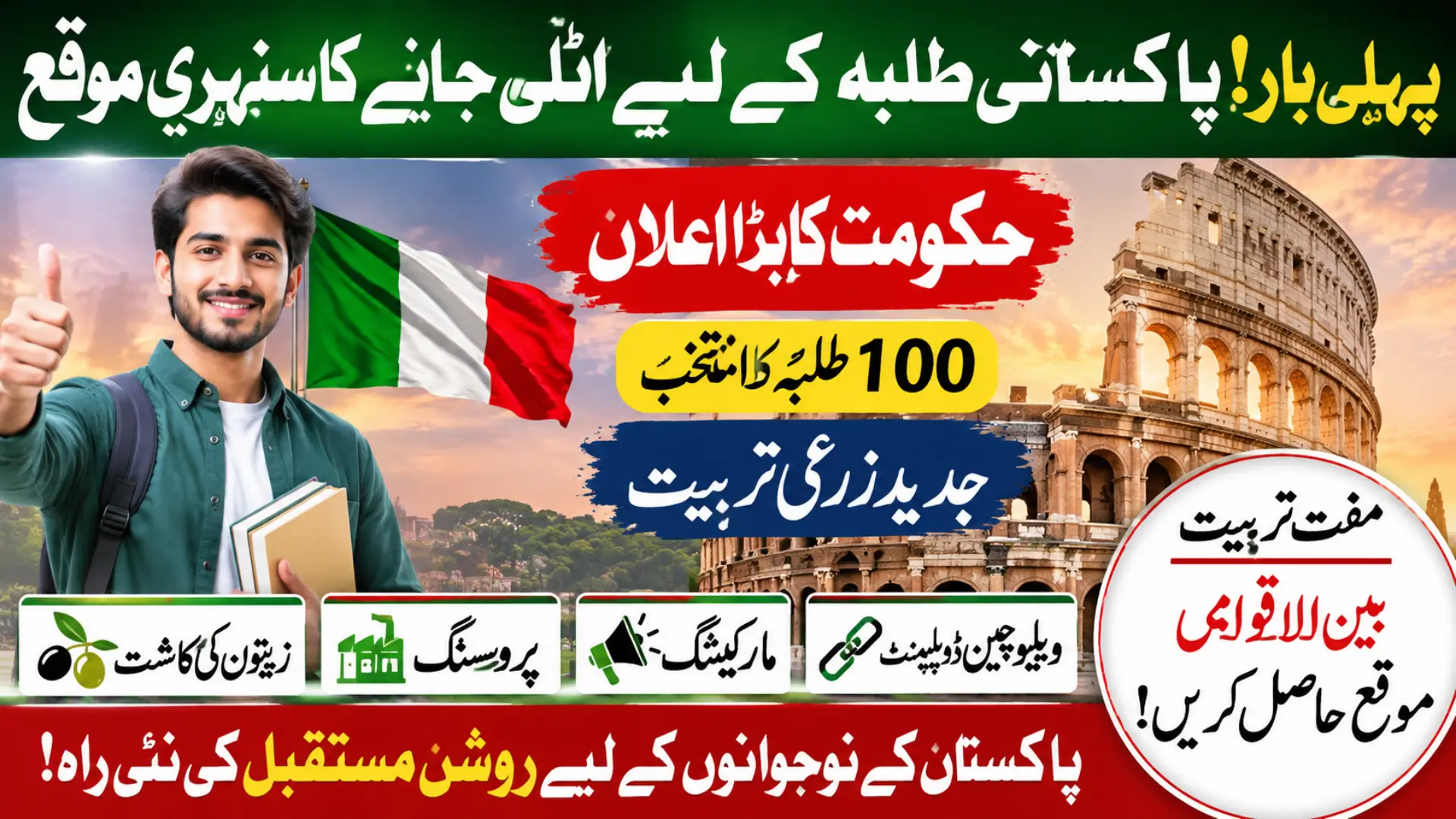
Pakistani Students to Get Training Opportunities in Italy Under New Govt Programme
Pakistani Students to Get Training Opportunities
Pakistani Students to Get Training Opportunities government has announced an international training opportunity for 100 young agricultural graduates from Pakistan, who will be sent to Italy to receive advanced training in olive cultivation and related fields. The initiative is part of efforts to strengthen Pakistan’s agriculture sector and improve the country’s olive value chain.
Prime Minister Shehbaz Sharif announced the programme while speaking at the launch ceremony of the Pakistan National Olive Value Chain Policy. The training will focus on practical and modern knowledge that can help Pakistan develop better olive production, processing, marketing and value-added products.
For Pakistani agricultural graduates, the programme could provide valuable exposure to international farming and business practices. It also reflects the government’s wider effort to reduce dependence on imported edible oil by increasing local production.
You Can Also Read: Punjab Schools to Host Mega Sports
Pakistani Students to Receive Specialized Training in Italy
Under the newly announced programme, 100 young agricultural graduates will have the opportunity to travel to Italy for specialized training. The focus will be on the olive sector, an area that Pakistan has been developing in recent years.
The training is expected to expose graduates to modern methods used in olive cultivation, processing and marketing. This international experience could help participants understand how a successful olive value chain operates from farming to the final product.
The initiative is particularly important because Pakistan needs trained professionals who can transfer modern agricultural knowledge to local farmers and businesses.
What the Italy Training Programme Will Teach Graduates
The programme is designed to cover several important parts of the olive industry rather than focusing only on farming. Graduates will learn about the complete process involved in producing and marketing olive-based products.
The main areas of training include:
- Modern olive cultivation techniques
- Olive processing and production
- Marketing of olive products
- Value chain development
- Value chain management
- Modern approaches to improving agricultural productivity
Learning these areas together can give graduates a broader understanding of the industry. Instead of concentrating only on growing olives, they can learn how agricultural products can be processed, marketed and developed into commercially valuable products.
You Can Also Read: FBISE HSSC Result 2026 Date & Time
PM Shehbaz Sharif Highlights the Potential of Pakistan’s Olive Sector
Prime Minister Shehbaz Sharif highlighted the importance of the olive sector while launching the National Olive Value Chain Policy. He appreciated the contribution of farmers, researchers and exporters who have been working to develop olive cultivation in Pakistan.
He also described olive oil as a healthy product and emphasized the need to further develop the sector. The government believes that stronger domestic olive production can create opportunities for farmers while also supporting the country’s wider agricultural economy.
The prime minister’s remarks also underline the importance of cooperation between different parts of the agriculture sector. Farmers, researchers, graduates, processors and exporters can all play different roles in building a stronger olive industry.
Pakistan’s Olive Cultivation Expands Across 60,000 Acres
According to the information shared by the prime minister, olive cultivation in Pakistan has expanded to around 60,000 acres. This shows that the crop is becoming an increasingly important part of the country’s agricultural landscape.
However, increasing the cultivated area alone may not be enough. Farmers also need access to modern techniques, suitable facilities and better knowledge about processing and marketing.
This is where trained agricultural graduates could potentially make a difference. After gaining international exposure, skilled professionals can help connect modern agricultural practices with local farming needs.
Key Olive Sector Figures
| Area | Details |
|---|---|
| Agricultural graduates for Italy training | 100 |
| Olive cultivation in Pakistan | Around 60,000 acres |
| Annual edible oil imports | Around $4 billion |
| Potential savings highlighted by PM | Around $400 million |
How Italy-Pakistan Cooperation Can Support Modern Agriculture
Pakistan and Italy already have cooperation in several areas, and agriculture is an important part of this relationship. Prime Minister Shehbaz Sharif said cooperation between the two countries in agriculture, tractor manufacturing and other sectors is significant.
The government intends to further expand cooperation in olive production, value addition and modern processing. Such collaboration can give Pakistani professionals an opportunity to understand technologies and methods being used internationally.
For students and graduates, overseas training can also provide practical exposure that may not always be available through classroom education alone. They can observe modern systems and understand how agricultural products move from farms to processing facilities and markets.
You Can Also Read: Punjab Schools Reopen After Summer
Olive Oil Production Could Help Reduce Pakistan’s Import Bill
Pakistan spends around $4 billion every year on edible oil imports, creating a major burden on the country’s import bill. Increasing local production could help reduce the need to purchase some edible oil from international markets.
Prime Minister Shehbaz Sharif pointed out that even saving around $400 million through increased domestic production would be a significant contribution to the national economy. This gives the olive sector an importance that goes beyond farming.
Developing local edible oil production could potentially help Pakistan in several ways:
- Reduce dependence on imported edible oil
- Save valuable foreign exchange
- Create new opportunities for farmers
- Encourage agricultural investment
- Support local processing industries
- Create employment opportunities across the value chain
The key challenge will be turning agricultural potential into consistent commercial production. Better training, processing facilities and market access will therefore remain important.
You Can Also Read: FBISE HSSC Result 2026 Date Announced
Government Plans to Promote Other Oilseed Crops
The government’s strategy is not limited to olives. Prime Minister Shehbaz Sharif also called for greater promotion of palm oil and sunflower cultivation to help reduce the country’s edible oil import requirements.
Promoting different oil-producing crops can give farmers more options while helping Pakistan build a broader domestic edible oil sector. Each crop has its own cultivation requirements, so research and region-specific agricultural guidance will be important.
A diversified approach could also reduce the country’s reliance on a single source of domestic edible oil production. With appropriate planning and farmer support, different crops can contribute to the larger goal of reducing imports.
Support for Farmers Becomes Key to Agricultural Growth
The prime minister said provincial governments have supported farmers and expressed appreciation for their cooperation in promoting olive cultivation. He stressed that farmers need continued support if Pakistan is to achieve an agricultural transformation.
Federal and provincial governments are expected to work together to provide better facilities for farmers. Such support can include access to modern knowledge, improved agricultural infrastructure and assistance throughout the production process.
For ordinary farmers, the success of any agricultural policy ultimately depends on what happens in the field. Policies and training programmes can have a greater impact when farmers receive practical support that helps them improve production and earn better returns.
You Can Also Read: New Traffic Measures Announced to Ease School Traffic
What the Programme Could Mean for Young Agricultural Graduates
The Italy training programme could give young agricultural graduates an opportunity to gain specialized knowledge outside Pakistan. Exposure to international agricultural systems can help them understand modern production methods and the business side of farming.
The graduates could eventually become a link between international expertise and Pakistan’s agricultural communities. Their knowledge may be useful in farms, research institutions, processing businesses and other parts of the olive value chain.
The programme may also encourage young professionals to view agriculture as a modern field with opportunities in technology, processing, marketing and exports rather than farming alone.
Pakistan’s Olive Industry and Future Growth Potential
Pakistan’s growing olive cultivation provides a foundation for developing a stronger domestic olive industry. However, long-term success will depend on more than increasing the number of olive trees or expanding farmland.
The country needs an effective system covering cultivation, harvesting, processing, packaging, marketing and sales. Value addition can help farmers and businesses get more economic benefit from the crop instead of relying only on raw agricultural production.
If training programmes, farmer support, modern processing and market development move forward together, Pakistan could strengthen its olive sector and create new opportunities for both agricultural graduates and farmers.
You Can Also Read: Punjab Education Boards to Fill Vacant
Why the National Olive Value Chain Policy Matters
The launch of the National Olive Value Chain Policy signals a broader focus on developing the olive industry as a complete economic chain. The emphasis is not simply on growing olives but also on improving processing, marketing and value addition.
This approach can help address some of the weaknesses that often affect agricultural products after they leave the farm. Better coordination between producers, processors, researchers and marketers can make the industry more organized and commercially sustainable.
For Pakistan, the bigger objective is clear: increase local agricultural production, support farmers, develop skilled professionals and reduce pressure created by imported edible oil.
Frequently Asked Questions
How many Pakistani agricultural graduates will be sent to Italy?
The government has announced that 100 young agricultural graduates will be sent to Italy for advanced training related to the olive sector.
What will the graduates learn in Italy?
The training will focus on areas including olive cultivation, processing, marketing and value chain development and management.
Why is Pakistan sending agricultural graduates to Italy?
The main purpose is to provide young graduates with modern knowledge and international exposure that can contribute to the development of Pakistan’s olive industry.
How much does Pakistan spend on edible oil imports?
Prime Minister Shehbaz Sharif said Pakistan imports edible oil worth around $4 billion annually.
How can olive production benefit Pakistan?
Greater domestic olive production could help increase local edible oil supplies, provide opportunities for farmers and potentially reduce the country’s dependence on imports.
Is the government promoting crops other than olives?
Yes. The prime minister also emphasized the promotion of palm oil and sunflower cultivation as part of efforts to reduce Pakistan’s edible oil import burden.
Final Words
The decision to send 100 Pakistani agricultural graduates to Italy for specialized olive-sector training is an important step toward building technical expertise in the country’s agriculture sector. The programme combines education, international cooperation and agricultural development.
Pakistan has already expanded olive cultivation to around 60,000 acres, but the next challenge is to develop a complete and efficient value chain. Training young professionals in cultivation, processing and marketing could help provide the expertise needed for that transition.
If government support, farmer participation, research and international cooperation continue together, Pakistan’s olive sector could become an increasingly important contributor to agricultural growth and efforts to reduce the country’s edible oil import bill.

3 Comments